

Si usted o un ser querido tiene problemas con apnea del sueño, EPOC o dificultades respiratoriasQuizá haya oído hablar de la Máquina BiPAP. Aunque es similar a un CPAP, funciona de forma diferente y puede cambiar la vida en determinadas afecciones.
In this guide, we'll explain what a BiPAP machine is, how it differs from CPAP, its uses, benefits, UK pricing, and answer the most common questions people ask before starting BiPAP therapy.
Explicación de la máquina BiPAP
A diferencia de la CPAP, que suministra una presión constante, una La máquina BiPAP ajusta el flujo de aire based on whether you're inhaling or exhaling.
- Apoyo a la inhalación (IPAP): Ayuda a impulsar el aire hacia los pulmones.
- Alivio de la espiración (EPAP): Reduce la presión al espirar, haciéndolo más cómodo.
- Integración de la oxigenoterapia: Algunos ventiladores BiPAP pueden combinarse con concentradores de oxígeno para pacientes con niveles bajos de oxígeno.
This makes BiPAP especially useful for patients with weaker lung function or more complex breathing needs.
Looking for advanced home therapy?
Shop BiPAP & CPAP Machines UKWhat Exactly Does a BiPAP Do?
A BiPAP machine supports breathing by delivering two different air pressures through a mask: a higher pressure as you breathe in, and a lower pressure as you breathe out. This reduces the effort needed to exhale, which is why BiPAP is often used for people who find a single fixed CPAP pressure uncomfortable or insufficient.
BiPAP vs. CPAP: What's the Difference?
Ambas máquinas ayudan a respirar, pero sus mecanismos difieren:
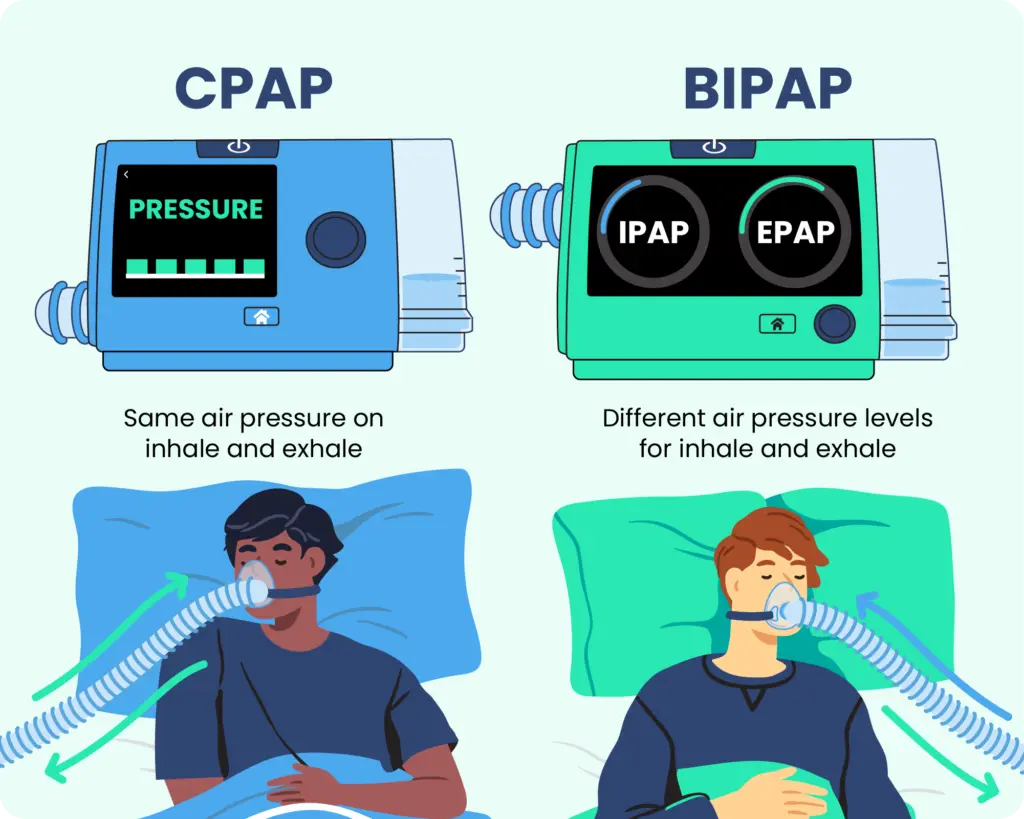
- Máquina CPAP: Delivers continuous air pressure, the same level for inhale and exhale.
- Máquina BiPAP: Offers two pressure levels, higher for inhale, lower for exhale.
Cuándo se prefiere la BiPAP a la CPAP:
- For patients with COPD, heart failure, or central sleep apnea.
- When CPAP is too uncomfortable due to high exhalation pressure.
- In hospital settings, BiPAP may also serve as a non-invasive ventilator for acute breathing failure.
If you're unsure whether CPAP or BiPAP is right for you, see our full comparison guide: CPAP frente a BiPAP: Cuándo usarlos para la apnea del sueño.
How Long Can a Person Stay on a BiPAP Machine?
Most people use BiPAP long-term, every night, for as long as their underlying condition requires it, similar to CPAP. There's no fixed limit on how long someone can use it. In hospital settings, BiPAP may be used continuously for shorter periods during an acute breathing episode, then withdrawn once the person is more stable.
Is Being Put on a BiPAP Serious?
Being started on BiPAP for a chronic condition like sleep apnea or COPD is not typically an emergency, it's a planned therapy decided with your doctor. Being placed on BiPAP in a hospital setting for acute breathing difficulty is more serious, as it usually means your provider is closely supporting your breathing while treating the underlying cause.
Ready to explore BiPAP therapy at home?
Shop BiPAP Machines UKVentajas del uso de una máquina BiPAP
- Respiración más fácil: Reduce el esfuerzo necesario para exhalar.
- Mejores niveles de oxígeno: Mejora el flujo de aire en pacientes con afecciones pulmonares o cardíacas.
- Alivio de los síntomas de la apnea del sueño: Evita las pausas respiratorias y mejora la calidad del sueño.
- Favorece la salud del corazón: Reduce la tensión del sistema cardiovascular.
- Flexibilidad: Can be combined with oxygen therapy for advanced care.
Preguntas frecuentes sobre las máquinas BiPAP
¿Para qué se utiliza una máquina BiPAP?
A BiPAP machine is used to treat sleep apnea, COPD, heart failure, and other breathing disorders. It provides breathing support for patients who struggle with CPAP.
¿Se considera un BiPAP soporte vital?
In some cases, yes. While not the same as full mechanical ventilation, a BiPAP can act as a non-invasive ventilator in hospitals or at home to support breathing.
¿Por qué utilizar BiPAP en lugar de CPAP?
BiPAP is used instead of CPAP when patients need different pressures for inhale and exhale, or cannot tolerate continuous CPAP pressure. It's especially useful for COPD and heart failure patients.
¿Qué ventajas tiene dormir con una máquina BiPAP?
BiPAP improves sleep quality and oxygen levels, and reduces snoring and apnea episodes. Patients often wake up more energized, with better heart and lung function.
¿Cómo ayuda BiPAP a la insuficiencia cardíaca?
BiPAP reduces the effort required to breathe, improves oxygen delivery, and lowers the workload on the heart, which is beneficial for patients with heart failure.
¿Utilizan BiPAP los pacientes con EPOC?
Yes. BiPAP is widely prescribed for COPD patients, as it helps ease breathing, reduce carbon dioxide buildup, and improve oxygen intake.
¿Aumenta BiPAP la tensión arterial?
No. In fact, BiPAP often helps reduce blood pressure in sleep apnea patients by improving oxygenation and reducing strain on the cardiovascular system.
For NHS guidance on breathing support and sleep apnea treatment, see the NHS overview of sleep apnoea.
A BiPAP ventilator provides advanced breathing support by offering two pressure levels, making it ideal for patients with sleep apnea, COPD, and heart conditions. Unlike CPAP, BiPAP is easier to exhale against, improving comfort and oxygenation.
Explore Broxtal's full range of BiPAP and CPAP machines.
Shop Sleep Therapy UK