
The honest answer: posture correctors can reduce muscle activity in the upper back in the short term and may help you notice when you're slouching, but current research does not show they reliably reduce pain, and they're not a fix for structural issues like scoliosis or a fatty neck hump. If you're considering one, this isn't a sales pitch, it's a plain look at what the studies actually found, where a corrector can genuinely help, and where it can't.
What Does the Research Actually Say?
There isn't a large body of high-quality evidence on posture correctors specifically, and what exists is mixed. Two studies are worth knowing about.
A 2023 randomised controlled trial published in Healthcare tested a scapular brace on healthy university students during a 30-minute typing task. The brace significantly reduced activity in the trapezius muscles (the muscles across the upper back and shoulders) compared to not wearing one. But the same study found no significant difference in reported pain, fatigue, or neck alignment between wearing the brace and not wearing it. In other words, it changed muscle activity without changing how people actually felt.
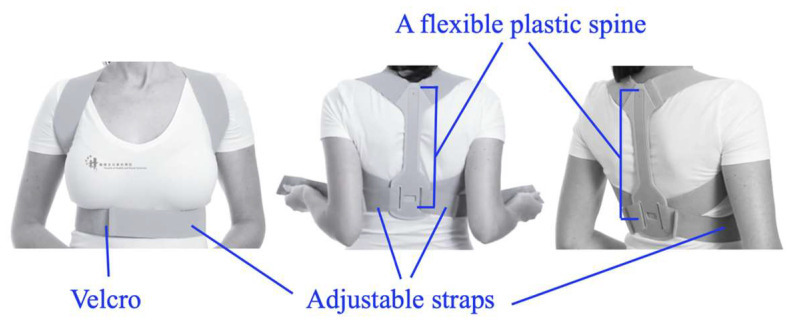
The scapular brace design used in Leung et al. (2023), Healthcare, 11(11), 1555. Reproduced under the journal's open-access licence.
A 2019 scoping review in the Scandinavian Journal of Pain looked specifically at posture-correcting shirts. Out of a much larger initial search, only 6 studies were judged good enough quality to include, and most of those studies used participants who weren't in pain to begin with, which makes it hard to know how well a corrector works for someone who actually has discomfort. The review's conclusion was direct: the evidence doesn't currently support recommending posture-correcting garments as a treatment for musculoskeletal pain.
Sources: Leung et al., "Effects of Using a Shoulder/Scapular Brace on the Posture and Muscle Activity of Healthy University Students during Prolonged Typing," Healthcare, 2023 (PMID 37297695). Palsson et al., "The use of posture-correcting shirts for managing musculoskeletal pain is not supported by current evidence," Scandinavian Journal of Pain, 2019 (PMID 31075089).

The takeaway from the current evidence isn't "they don't work" or "they do work", it's that the research is still limited, and what exists points to a modest, short-term effect rather than a cure.
Do Posture Correctors Help with Back Pain?
Not reliably, based on current evidence. The NHS's own guidance on back pain doesn't feature bracing or posture correctors at all, the leading advice is to stay active, continue normal daily activities, and use gentle movement and, where needed, anti-inflammatory medicine. Bed rest and immobilising the back are specifically discouraged because they can slow recovery. A posture corrector isn't harmful for most people to try alongside that advice, but it isn't a substitute for it, and it shouldn't be the first thing you reach for if you're dealing with genuine back pain.
Curious what a well-made posture corrector actually feels like day to day?
See Our Posture CorrectorsWill a Posture Corrector Fix a Neck Hump?
It depends entirely on what's causing it, and "neck hump" isn't a single medical condition, it's an informal name for a few different things:
- Postural kyphosis (rounding of the upper spine from years of forward head posture): a corrector may help you notice and correct your position through the day, as one part of a routine that also includes targeted exercise, this is the scenario where a corrector has the best chance of being genuinely useful.
- A fat pad ("buffalo hump") at the base of the neck: this is soft tissue, not spinal curvature, and a posture corrector won't reduce it. It's sometimes linked to weight, certain medications, or hormonal conditions, and is worth mentioning to a GP if it's new or growing.
- Osteoporosis-related structural change in older adults, from vertebral compression: this needs medical assessment, not a posture garment.
If you're not sure which of these applies to you, that's a reasonable thing to ask a GP or physiotherapist before assuming a posture corrector is the answer.
Are Posture Correctors Safe to Use for Scoliosis?
Consumer posture correctors like the ones sold on this site are not scoliosis treatment, and we want to be direct about that. Scoliosis bracing is a custom-fitted clinical device, made and adjusted for an individual's specific curve by a specialist. According to NHS guidance, even proper clinical bracing cannot cure scoliosis or correct the curve, at best it may help stop the curve worsening in some cases, and it isn't recommended by all scoliosis specialists. A generic posture corrector is a different product entirely and isn't designed or evidenced for scoliosis. If you have diagnosed or suspected scoliosis, that's a conversation for your GP or an orthopaedic specialist, not something to self-manage with a posture garment.
Can They Help with Neck Pain?
The same 2023 study covered earlier is directly relevant here: wearing a scapular brace reduced upper trapezius muscle activity but made no measurable difference to reported pain or neck alignment during the task. That doesn't mean a corrector can't help some people feel more supported, but it does mean you shouldn't expect it to resolve neck pain on its own. If neck pain is persistent, worsening, or came on suddenly, that warrants a GP or physio assessment rather than a posture garment as a first step.
How Long Before You'd See Results?
This is genuinely hard to answer with precision, because the highest-quality studies available measured short-term, immediate effects during a single session, not weeks or months of regular use. What we can say honestly: any change in muscle activity appears to happen immediately while wearing the device, but there isn't strong evidence for a lasting change in posture or pain once you take it off, particularly without also working on the underlying muscle strength and habits. If you try one, think of it as an awareness tool you build a habit around, not something that "fixes" posture on a set timeline.
Are There Any Side Effects?
- Wearing a posture corrector for very long periods, especially a rigid or heavily supportive one, may lead to over-reliance on it rather than your own postural muscles doing the work, some clinical commentary suggests passive bracing can weaken postural muscles over time if it becomes a substitute for exercise rather than a supplement to it.
- Some people find longer wear uncomfortable across the shoulders or underarms, particularly with a poor fit.
- A corrector that's too tight can restrict breathing or circulation, sizing correctly matters.
- If you have an existing back, shoulder, or nerve condition, check with a physio or GP before wearing one regularly.

Most people who benefit from a posture corrector use it in short, regular sessions, not all day, treating it as a reminder to sit and stand well rather than something that does the work for them.
Who Actually Benefits from a Posture Corrector?
Based on the evidence, the realistic use case is narrower than the marketing around these products often suggests:
- People who sit for long periods and want a physical reminder to sit upright, particularly during desk work.
- People in the early stages of noticing rounded shoulders or forward head posture, using it alongside exercise rather than instead of it.
- People recovering from a minor strain who want short-term support during specific activities, with GP or physio input.
It's a less realistic fit for anyone expecting it to resolve chronic pain, correct scoliosis, remove a fat-based neck hump, or replace exercise and physiotherapy entirely.
If a posture corrector fits your situation, our buying guide covers how to pick the right one.
De bästa hållningskorrigatorerna i Storbritannien 2026Vanliga frågor
Do posture correctors actually work?
They can reduce muscle activity in the upper back in the short term, shown in at least one randomised trial, but the same research found no significant effect on pain, fatigue, or neck alignment. Evidence for lasting improvement is currently limited.
Can a posture corrector fix a neck hump?
Only if the cause is postural (kyphosis from years of forward head posture), and even then it works best alongside exercise, not alone. If the hump is a fat pad or related to osteoporosis, a posture corrector won't resolve it.
Are posture correctors safe for scoliosis?
Consumer posture correctors are not scoliosis treatment. Scoliosis requires a custom-fitted clinical brace prescribed by a specialist, and even that can't cure or correct the curve, only potentially slow progression in some cases.
How long do you need to wear a posture corrector to see results?
Current research has mostly measured immediate, short-term effects rather than results over weeks or months. There isn't strong evidence for a fixed timeline, treat it as a habit-building tool rather than something with a guaranteed results date.
Do posture correctors have side effects?
Overuse may lead to reliance on the device rather than your own muscles, especially with rigid designs. Poor fit can cause discomfort or restrict breathing and circulation. Anyone with an existing condition should check with a GP or physio first.
För ytterligare vägledning, se NHS back pain guidance.
Explore the full range of posture support options.
Shop Posture Correctors